Santo Sigung talks about Chinese Internal Art Posture. Enjoy!
Showing posts with label Chinese arts. Show all posts
Showing posts with label Chinese arts. Show all posts
Saturday, March 9, 2013


Wednesday, September 5, 2012
Yoga and Qigong: Two Streams From a Single Source
By Sat Hon,
Founder, New York Dan Tao Center, author of "Taoist Qigong for Health and Vitality." Huffington Post | August 2012
In the hunt for the common ancestor of yoga and qigong, one discovers that unlike its progenies, it existed in a form that has long vanished in the sands of time and remains buried beneath layers of foreign invasions. I know the disciplines of yoga and qigong quite well, yet nonetheless the search for their common ancestor drives me deep into ancient texts, old forgotten sutras and temple dancing figures, all of which are relics derived from this single source. Over days, months and years I continue to pursue this form -- these sacred movements and postures -- no longer found within any living tradition.
What is the origin of yoga, or more specifically of hatha yoga, the physical/mental cultivation of the spiritual path of yoga? The root of yoga is the Sanskrit word yuj, which suggests a discipline of binding -- to "yoke" one's habitual conditioning in order to liberate the practitioner from the bondage of greed, fear, obsession and indolence. The core of Indian spirituality is propelled by four dynamic concepts: karma (causality), maya (illusory existence), nirvana (liberation), and yoga (cultivation). It is at this juncture that we face a real danger of getting lost on our way down this dark, ancient, subterranean passageway of Indian culture and religion. For this exploration, it suffices to know that yoga is one of the four pillars of Indian spirituality, the concrete cultivation and practice that can lead one toward nirvana, liberation and spiritual enlightenment.
At this point, we must cross over a continent into yet another antiquity, China circa 500 AD during the Tang dynasty. A traveler would have been impressed and overwhelm by China's civilization with its great cultural refinements, the flowering of all aspects of scientific, social and economic development. One can surmise that the Buddhist mendicant monk, Bodhidharma, must have felt a sense of utter bewilderment, as he came from the relatively rural society of ancient India. Bodhidharma had a vision that he would be the one to bring Buddhism into China, the Middle Kingdom. Bodhidharma was like most well-educated upper-class Indians and he was also a prince of a small neighborhood kingdom; thus, we can deduce that he was probably educated in the four basic pillars of yoga. According to unofficial anecdotes, by virtue of his yogic accomplishment he was able to cross the Yellow River by treading on a single reed stalk. Furthermore, according to the same legend, when this Indian monk arrived at the Shaolin monastery, he was shocked by the state of decline and the weakened physical state of the monastic brotherhood as most of them fell asleep during his sermon on the transcendental heart-to-heart instantaneous enlightenment of the Ch'an Buddhist teaching. Thus, Bodhidharma decided to teach yoga to the monks in order to strengthen and develop the vitality necessary for their spiritual cultivation. Within the next century, his yoga was then absorbed and integrated into the Chinese indigenous form of physical/mental practice, qigong. Illustrated here is an example of qigong as compared to yogic asana:

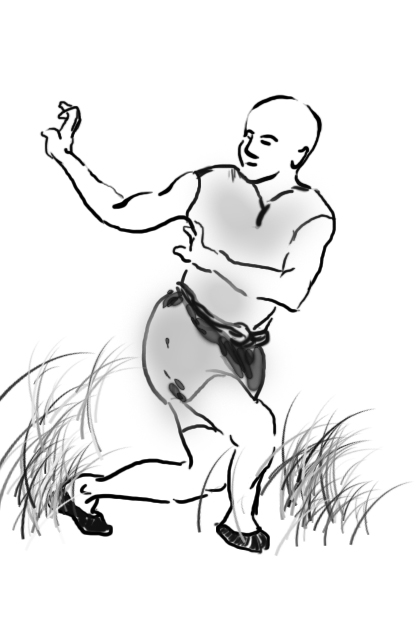
Yogic asana Spinal Twist, contrasted with the qigong posture Tiger Gazing Back: Notice that in both these postures there is a common spinal twist. Hence, both have a strengthening effect upon the core muscle group of the spinal column and would improve one's core strength.
Wednesday, July 27, 2011
Qi Magazine Archives
In the coming weeks, we will be featuring material from deep within the Qi Magazine archives. Qi Magazine was a newsstand periodical launched in the mid-1990s to cover the world of qigong and inform the English-speaking world of the spectrum of practice and thought being offered by various master practitioners in the West. Each issue of Qi Magazine is built around a number of short feature articles that provide insight from the wisdom of one of the more notable qigong masters, introduce an element of basic practice, or discuss the value of a form of Chinese medicine. Many of these are illustrated with detailed diagrams of the body or of the movements being discussed. There is a large letters-to-the-editor column in which readers are invited into a lively dialog with the editorial staff. The magazine grew from a small black and white booklet to a proper magazine that was distributed all over the world. Sadly Qi Magazine has now ceased production, but not after 18 years and 90 issues all packed with rare and unique articles covering all aspects of Chinese Qigong, martial arts, culture and philosophy.
-------
Qi Magazine First Issue (1991)
Dear Qigong Supporters,
Firstly, I wish to thank all of you for supporting Qigong and chinese health exercises, over the past three years since my arrival in England. I have decided to publish this new magazine devoted to Qigong and related Chinese arts because I want more people to understand and to get benefit from Qigong, by improving their health and develop to their full potential. A lot of people who practice Qigong have questions, but are unable to find the answers. Sometimes they are mislead by books written by people who do not fully understand Qigong, consequently some practitioners consider quitting! On the other hand there is not much literature or information on Qigong, and this magazine aims to change that by revealing the secrets of Qi internal development and health.
Why do some people live longer?
Why do some people get ill very easily?
Why do many people get old at only 40 or 50?
If we can understand our Qi we can all live much longer lives. I believe that the 90's is the decade for health. We should try to understand our health potential and search for long life. I want everyone to have more information and contact with each other, and I hope that his magazine will attract other Qigong or Taiji masters, who have similar aims of promoting awareness and development in these arts. I sincerely hope that Qi Magazine attracts a worldwide readership and results a greater understand and discussion of Qigong.
Qi Magazine will be distributed in Great Britain, United States, Sweden and Canada, and translated into German for readers in Germany, Switzerland and Austria. I hope that it will become known as an unbiased magazine and raises the awareness of the general public and the knowledge and skills of Qigong practitioners everywhere.
Yours Truly,
Michael Tse
Subscribe to:
Posts (Atom)